German
 Croatian
 Czech
 English
 French
 Hungarian
 Italian
 Polish
 Slovak
 Slovenian
 Spanish






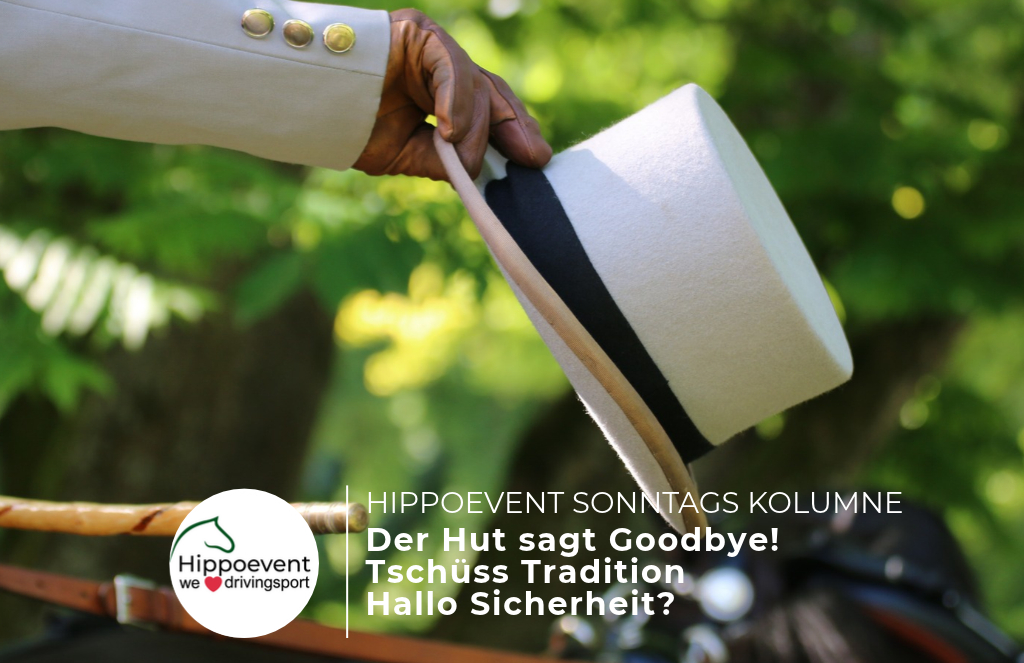
Goodbye Tradition – Hello Safety?
A personal Sunday column about the changing face of carriage driving, living traditions, new safety regulations and the question of what truly makes our sport unique.
By Jacqueline Zimmermann
The hat is disappearing. From 2027, a new era will begin in international FEI Driving: protective helmets will become compulsory in all three phases. The top hat, the elegant hats worn by female drivers and, with them, a part of the distinctive appearance that has shaped carriage driving for decades will, at least in international competition, become a thing of the past.
Safety comes first. There is no arguing with that. But does it really have to go this far?
I would like to make one thing clear right at the beginning of this – admittedly rather lengthy – column: anyone who prefers to wear a safety helmet should absolutely be able to do so. But should every driver really be required to give up the traditional hat or elegant top hat, even in dressage? For many, these are an integral part of the appearance and identity of carriage driving.
Goodbye Tradition – Hello Safety?
A question that has made me think. And one that takes me back to my own beginnings in carriage driving.
How I discovered carriage driving …
I grew up with horses. Carriage driving was always there, so to speak, within reach. At home, at clinics and during training courses, I had plenty of opportunities to become involved in the sport. But, to be honest, it never really appealed to me back then. I simply didn't know enough about driving horses. My interest was in riding. Driving? No, that wasn't my world at the time.
Until one day, when I happened to visit a driving competition almost by chance.
It was an international driving event that also hosted the Danube-Alpine Cup. And that was exactly where it happened: I caught the carriage driving bug!
I was fascinated. By the beautiful turnouts, the magnificent horses, the finely crafted harnesses and the elegant carriages. By the drivers, their style and the wonderful sense of community surrounding the sport. By the partnership between horse, human and carriage. And, not least, by the traditions that were not simply displayed for show, but genuinely lived.
There were the English turnouts with collars and top hats, and the Hungarian turnouts with breastcollars and traditional hats. Different styles, different traditions – and every turnout had its own character.
What fascinated me was the attention to the overall presentation. It wasn't just about performance, but also about the way a turnout was presented.
And then there was that subtle communication between driver and horses! The reins, the voice, the discreet use of the whip. Even the whips came in different styles: the bow whip or the straight whip. It was all those little details that made carriage driving so special to me.
That was how I discovered carriage driving.
What has become of those traditions?
Through my work and my activities with Hippoevent, I have been able to follow international carriage driving for many years. I have observed developments, witnessed changes and seen how our sport has evolved over time.
But I have also watched the traditions that once fascinated me gradually move into the background.
Presentation assessments, as we used to know them, no longer exist. Even in the final dressage marks, correct harnessing and the overall presentation of a turnout seem to carry less and less weight. The overall impression, elegance and attention to detail – everything that once formed such an important part of the fascination of carriage driving for me – seems to be losing its significance.
I find that a shame. And I believe that, step by step, carriage driving is losing a part of its own identity.
In many ways, these traditions have also been closely connected to the horse, its use and its welfare.
So what is it that distinguishes our sport from other equestrian disciplines? It is precisely those special characteristics that make it unique: the different styles of harnessing and breeds of horses, the elegant and traditional clothing worn by drivers and grooms, the harnesses, the carriages and the individual styles of drivers from different regions.
We are not only losing a part of our culture and history, but potentially an important opportunity for the future as well. Tradition and individuality can also offer valuable opportunities to promote and market our sport.
A distinctive style, a characteristic type of turnout or an unmistakable appearance creates recognition – for drivers, sponsors and the sport as a whole.
At a time when so many sports are competing for attention, visibility and sponsorship, perhaps we should think twice before giving up the very characteristics that make carriage driving so unique.
Safety – yes, but let's talk about the facts!
Of course, sport must and should evolve. Safety standards need to be reviewed and improved. From a safety perspective, the decision to make protective helmets compulsory in all three phases is understandable. Naturally, every driver should have the option of wearing a helmet if that is their personal preference.
But with such a far-reaching change, another question arises: what do the accident figures in international carriage driving actually tell us?
How many accidents occur during dressage? What types of injuries are most common, and where do the greatest risks lie?
Does the FEI have reliable accident statistics broken down by phase and cause?
I would find such an overview extremely interesting. In particular, a comparison of the three phases over a longer period could provide valuable insights.
To the best of my knowledge, no such detailed statistics are publicly available. That does not mean the FEI has no relevant data. All the more reason, in my view, to make these figures transparent.
If we are going to talk about safety and new regulations, we should also be talking about facts. Reliable accident statistics could help us assess risks more accurately, identify developments and introduce targeted safety measures where they are genuinely needed most.
Safety should not be based on assumptions. It requires evidence, transparency and an objective discussion.
This does not mean that I fundamentally question the introduction of protective helmets. But I do believe that the driving community has the right to understand the background and reasoning behind decisions of this importance.
Should we simply accept everything that comes from above?
And this brings me to a more fundamental question: should the driving community simply accept everything the FEI decides? Especially when we consider that decisions at the FEI General Assembly are made by majority vote among National Federation representatives, many of whom do not directly represent active driving athletes?
For years, the FEI has pursued the goal of bringing the different equestrian disciplines more closely into line in various areas. Common standards, shared structures and comparable safety requirements may make sense in some respects. But I increasingly wonder whether the independence and individuality of individual disciplines are being lost along the way.
My personal impression is that carriage driving is too often the discipline left behind in these developments.
Carriage driving is not simply another variation of equestrian sport. It has its own history, traditions, specific requirements and a culture of its own. Its practice, equipment, presentation and sporting character differ considerably from those of ridden disciplines.
Driving is not riding!
Of course, we must continue to develop and take safety standards seriously. But does that mean that solutions and developments from other equestrian disciplines automatically have to be adopted in carriage driving as well?
I would like to see the particular characteristics of our sport given greater consideration in FEI decisions.
The representatives of active driving athletes at the FEI – I can hardly hear them!
Hippoevent is one of the internationally active carriage driving magazines. We follow the sport worldwide, report on international competitions and maintain contact with many athletes and officials. Yet we hear very little about any open discussion surrounding changes of this magnitude.
In my experience, enquiries to the Chair of the FEI Driving Committee have remained unanswered. I also find very little publicly available information explaining how the interests of active driving athletes are represented in these decision-making processes.
That raises questions.
An international governing body – and particularly those representing driving within the FEI – should not only establish uniform rules, but also protect the diversity and independence of its disciplines.
Who actually represents the interests of the drivers?
From the outside, it is difficult for me to judge the communication and cooperation between the athlete representatives, the people responsible for the FEI Driving Department and the FEI Driving Committee.
There is an athlete association recognised by the FEI and an athlete representative for driving. However, from my perspective, communication with the public and the media activity of both appear rather limited.
How intensive is the exchange between these bodies in practice? Are athlete representatives involved early enough in important decisions? Are the wishes, concerns and different interests of the international driving community adequately taken into account? And by that I explicitly mean all types of turnouts and all levels of competition – not just the top level of the sport.
And above all: how much of this is subsequently communicated to the wider community?
For rule changes of this significance, I would like to see greater transparency. Drivers should be able to understand how decisions are reached, which arguments have been discussed and how their interests and feedback have been taken into account.
Simply publishing information somewhere in the vast depths of the FEI website is, in my personal opinion – and as a representative of the media – not enough. Transparency also means actively providing information and seeking dialogue with the driving community.
I get the impression that personal or institutional interests sometimes carry greater weight than the involvement of the entire driving community.
This is not just about the opinions of a few top drivers or officials. Carriage driving is diverse. Different types of turnouts, national traditions and the needs of all internationally active drivers deserve to be heard when decisions of this kind are being made.
I would like to see cooperation in which decisions are not simply made and communicated afterwards, but in which the international driving community – and by that I really do mean all types of turnouts and all levels of international competition – is involved from the very beginning.
Carriage driving does not need special treatment at any cost. But it deserves to be recognised and treated as an independent discipline.
But what can we do?
What can we actually do when we are unhappy with developments like these? Simply regret that carriage driving is changing? Walk away from the sport? “This is no longer my sport” – I have heard that sentence far too often in recent years.
That is not enough for me.
I initially assume that the athlete representatives in international driving have discussed this rule change and that there have been conversations and consultations with active drivers. After all, this is a change that affects every driver competing at international FEI events.
However, whether and how the athlete representatives have put forward their views and the opinions of the driving community in discussions about this FEI rule change has not been communicated publicly – or I may have missed it. I would have liked to see more transparency and information.
But let us return to those of us who care about preserving the traditions of carriage driving.
Perhaps we can make a contribution ourselves. By continuing to showcase the different types of turnouts, beautiful harnesses, elegant carriages and the special presentation of our teams. By appreciating them and giving them a platform. By sharing these images, telling our stories and inspiring the next generation to discover the diversity and traditions of carriage driving.
Even if the rules change, we do not have to forget where our sport comes from and what makes it so special.
Perhaps now is precisely the time to enjoy once again the many wonderful images of carriage driving: the elegant turnouts, the different harnessing styles, the hats and top hats, and all those details that first inspired me and brought me into this sport.
Tradition does not live through rules alone. It lives through people who preserve it, pass it on and keep it alive with passion.
An international initiative – can we make a difference together?
Perhaps we should take this one step further.
What if we did not simply express our concerns in conversations and comments, but joined forces and took action?
Could an international online petition be a way of showing the FEI and its representatives that many people care deeply about the identity and traditions of carriage driving?
Not as a protest against safety, and not with the intention of questioning necessary safety measures. Rather, as a call to reconsider decisions, give greater recognition to the independence of our discipline and work together to find solutions.
FEI rulebooks are not set in stone for eternity. Developments can be reviewed, decisions questioned and improvements made. What is decided today does not necessarily have to remain unchanged forever.
And this applies to much more than the question of the hat.
Perhaps the time has come for the international driving community to make its voice heard. Together, constructively and across national borders.
And now it's your turn!
What do you think about these developments?
Is the hat simply an item of clothing that can be replaced by a safety helmet? Or are we losing a part of our sporting identity along with it?
Should everything that comes from the FEI simply be accepted? How important are tradition, presentation and individual style in carriage driving to you?
What can we do together to preserve the special traditions of our sport?
And what do you think about an international Hippoevent initiative to preserve the identity of carriage driving? Would you support such a petition?
Tell us what you think! We look forward to an open discussion – because our sport also lives through its community.
Jacqueline Zimmermann
Hippoevent – we love Driving Sport!