German
 Croatian
 Czech
Czech English
 French
 Hungarian
 Italian
 Polish
 Slovak
 Slovenian
 Spanish





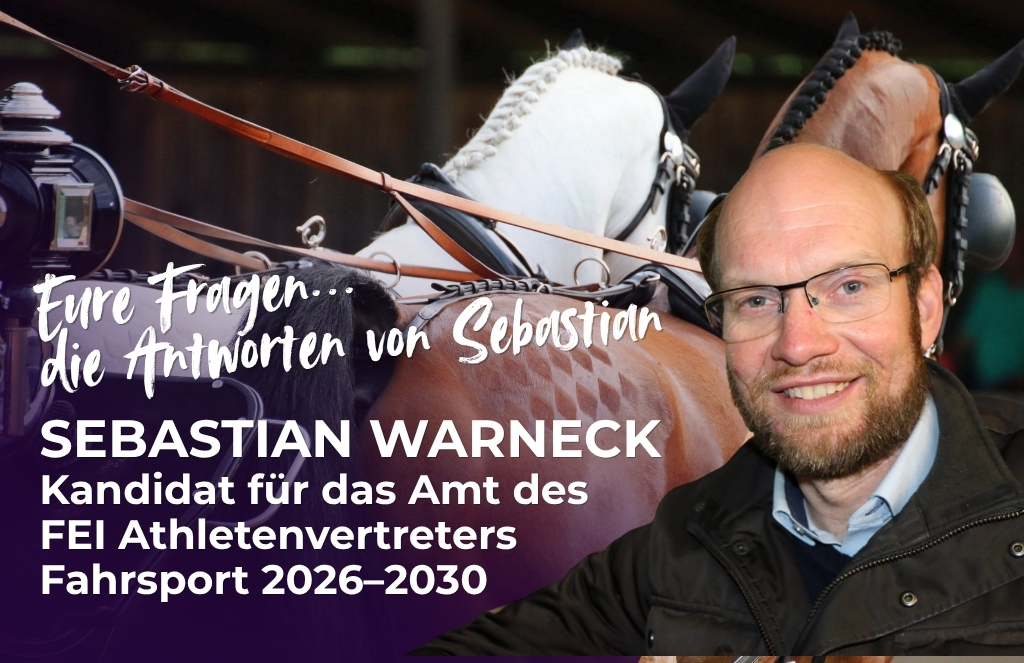
→ General Information – FEI Driving Athlete Representative Election 2026–2030
Who will represent the international driving community at the FEI?
The election for the FEI Driving Athlete Representative 2026–2030 is underway – and it directly concerns the international driving community. Who will represent the interests of active driving athletes within the FEI in the future and bring their voice into the relevant committees and decision-making bodies?
The election remains open until 31 October 2026 at 23:59 CET/CEST. Eligible driving athletes can still cast their vote online through the official FEI voting system.
Over the past weeks, numerous driving athletes have contacted Hippoevent and sent us their questions for the candidates. We have selected some of the most frequently raised and most relevant topics for the driving community and forwarded three questions to Sebastian Warneck.
Hello Sebastian – thank you for taking the time to answer the questions that have been sent to us by the Hippoevent driving community.
Question 1: The voice of the athletes – genuine representation or symbolic role?
Many driving athletes are calling for greater transparency and more genuine opportunities to influence FEI decisions.
As an Athlete Representative, how would you ensure that the concerns of driving athletes are not only heard, but actively incorporated into the decision-making process?
Sebastian: I believe that this is precisely one of the most important responsibilities of an Athlete Representative. It is not enough simply to have the opportunity to express your opinion. What really matters is that this opinion actually becomes part of the decision-making process.
For me, however, this starts with something very simple: personal contact. I want to try to be present at as many important international competitions as possible. That is the most important place for an Athlete Representative to be. Not simply to watch the competitions, but above all to be approachable for the drivers.
I want to be one of them there – to talk to the drivers, listen to them and understand what really concerns them. There are many things that matter to an athlete which you may not become aware of if communication takes place only via email or surveys.
Of course, I cannot be at every competition around the world. But especially at major championships and important international events, I want to be present and seek direct contact.
And then, of course, it is important that what I hear is also taken forward. I want to bring the athletes' concerns in a structured way to the relevant committees, and I consider it equally important to report back transparently afterwards: What happened with this issue? What was taken on board, and why was something perhaps not taken forward?
For me, athlete representation therefore does not mean simply being an additional voice on a committee. I want to create a genuine connection between the drivers and the FEI.
The drivers should know: There is someone I can approach, someone who listens to me and who will take my concerns forward.
Question 2: Rules and practice – where is there an urgent need for action?
In recent weeks, there has been intensive discussion about the interpretation of rules and the sometimes far-reaching consequences these interpretations can have for athletes. One example was the situation at the World Championship in Aachen and the elimination of three driving athletes.
How do you generally assess the handling of such situations? Where do you see a need for action to ensure that rules are clear, understandable and applied according to the same standards for all athletes?
Sebastian: I would not want to assess a specific case such as Aachen from a distance without knowing all the details and the respective decisions. But in my opinion, situations like these clearly demonstrate how important clear rules and transparent communication are.
An athlete needs to be able to know where they stand. Rules should not simply exist somewhere in the rulebook; they need to be understandable and, as far as possible, applied clearly and consistently in practice.
And particularly because of my professional background as a public prosecutor, one point is especially important to me: Rules must apply to everyone. There must not be different standards when they are applied.
If two athletes find themselves in comparable situations, the rule must be applied according to the same principles. That creates confidence in the fairness of the sport.
Of course, the specific circumstances of each individual case must be taken into account when making any decision. But the underlying rules and standards must be transparent and understandable for all athletes.
If there are different interpretations or if a rule has significant consequences for an athlete, it must therefore be possible to understand how the decision was reached and on what basis it was made.
My professional background is in an area where decisions have to be justified and comprehensible. That is why transparency is, for me, a very fundamental part of fairness.
And I believe this is precisely where an Athlete Representative can play an important role: If drivers feel that a rule or its application is unclear, there needs to be someone they can turn to who can take these questions to the relevant committees.
Question 3: Communication between the FEI, national federations and athletes – who carries the responsibility?
Athletes repeatedly report that important information or changes reach them too late or are not communicated sufficiently.
How do you assess transparency and communication between the FEI, national federations and athletes? Is the athlete ultimately the one who has to bear the consequences of inadequate communication – or do you see a clear responsibility on the part of the FEI and national federations to provide information?
Sebastian: For me, transparency is a very important foundation for trust and fairness in sport. And communication must not be a one-way street.
Of course, every athlete also has a responsibility to inform themselves about the applicable rules and changes. But I clearly also see the FEI and the national federations as having a responsibility to actively, promptly and clearly communicate important information to the athletes.
Especially when rules change or there are new interpretations that have a direct impact on the sport, I do not think it is reasonable to expect individual athletes to find everything out for themselves somewhere. If information has not been communicated sufficiently or in time, this should not ultimately be solely at the athlete's expense.
I see the FEI and the national federations as sharing this responsibility. The FEI must communicate its decisions and rule changes transparently, and the national federations must actually ensure that this information reaches their athletes.
I would therefore like to see communication work more strongly in both directions: Federations should not only inform athletes, but also listen to the questions and problems that arise in practice.
That is exactly where I also see the role of the Athlete Representative. I want to create this connection – bringing information from the FEI to the drivers, but equally bringing the experiences and concerns of the drivers back to the FEI.
And there is one point that is particularly important to me: Communication should not only take place once a problem has already occurred.
If we communicate with each other openly and transparently at an early stage, many misunderstandings and conflicts can probably be avoided.
Ultimately, it comes down to a simple principle: Athletes must have the opportunity to know the rules, understand them and be able to rely on them. For this, we need reliable communication between the FEI, national federations and athletes.
Thank you, Sebastian!
FEI Driving Athlete Representative Election 2026–2030
Your vote matters. Your voice matters.
The election remains open until 31 October 2026 at 23:59 CET/CEST.
All information about the FEI Driving Athlete Representative Election 2026–2030, the candidates, voting eligibility and how to cast your vote can be found on Hippoevent.
→ ALL INFORMATION ABOUT THE FEI DRIVING ATHLETE REPRESENTATIVE ELECTION 2026–2030
Get informed. Get involved. Use your vote – and help shape the future of international driving sport.
Make your voice count for a driving sport that takes the needs of both horses and driving athletes into account.